
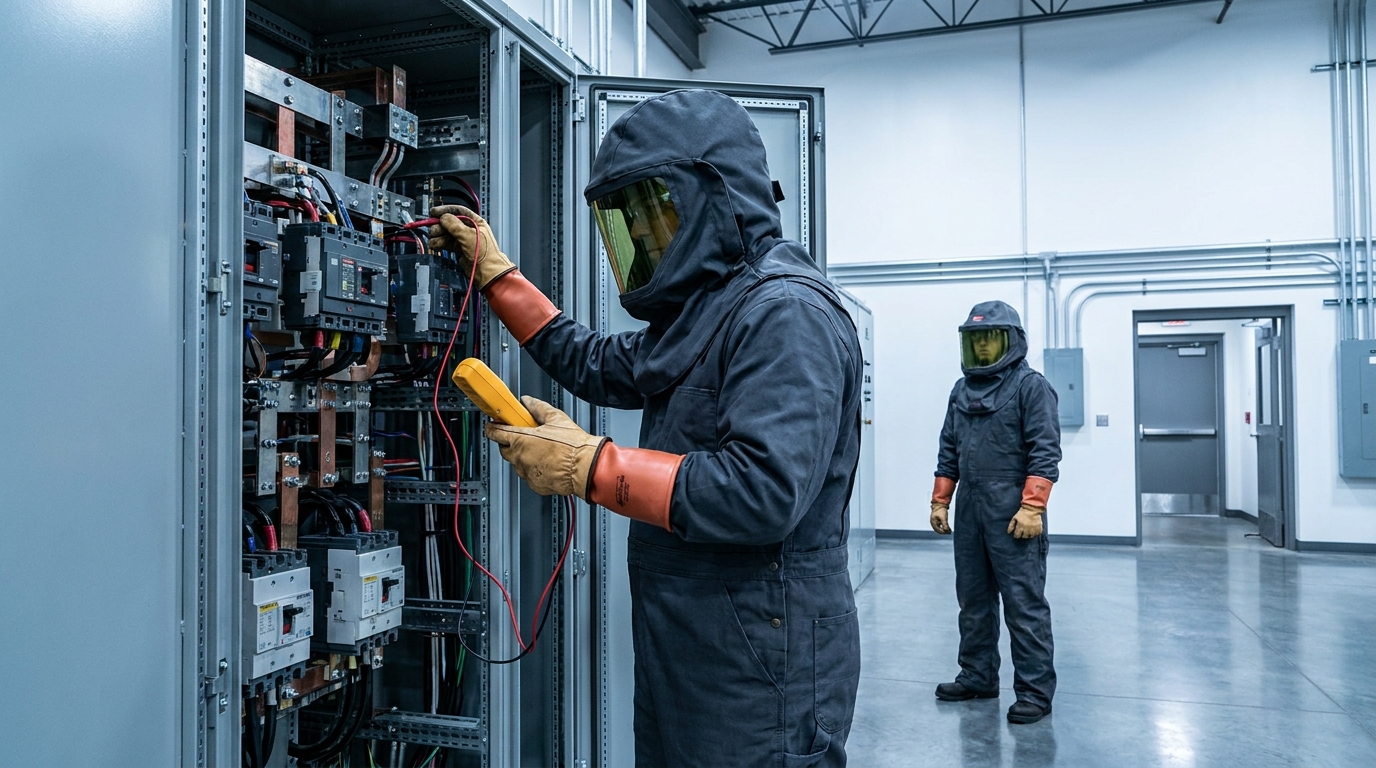
When someone is shocked or caught in an arc flash, the first few seconds decide the outcome, and a worker alone at an open cabinet has nobody to change them. The 2027 edition of NFPA 70E addresses that gap directly by requiring a second, trained person to be on hand whenever permitted energized work is under way.
This article breaks down what the second-person requirement says, who can and cannot fill the role, when it applies, where it will hurt staffing, and how to prepare your crews and permits before the requirement becomes enforceable.
What is the NFPA 70E second-person requirement?
The second-person requirement, written into the 2027 edition of NFPA 70E as an “additional person” rule, says that when justified energized work requires an Energized Electrical Work Permit, a trained additional person must be present, outside the boundaries, ready to respond to an emergency. It is a change to Article 130, the part of the standard that governs work performed within the limited approach boundary or the arc flash boundary.
NFPA 70E, the Standard for Electrical Safety in the Workplace, has long said that energized work should be the exception. Work is supposed to be done de-energized unless de-energizing creates greater hazards or is infeasible. What the standard did not do before was say who else has to be standing there when that exception is exercised. The new provision closes that gap.
The current, enforceable edition is still 2024. The next edition was in the final stages of NFPA’s standards-development process as this article was written, so the wording below reflects the requirement as reported through the drafting record and trade press. Confirm the final text with NFPA before you rewrite procedures around it.
What does the additional person actually have to do?
The additional person is a standby rescuer, not a second set of hands. That single distinction drives almost every practical question about the rule.
Training
The additional person has to hold the emergency response training that 70E already expects of qualified workers, which the trade press describes as centered on releasing a victim from contact with energized conductors. In practice, that means someone who knows how to recognize a contact event, how to remove a victim from the circuit safely, and how to summon help immediately.
Position
The additional person is positioned in the vicinity of the work but outside the limited approach boundary or the arc flash boundary, whichever is greater. That placement is deliberate. A person standing inside either boundary is exposed to the same hazard as the worker and cannot rescue anyone if the same event takes both of them out.
Role
The additional person is watching, not working. If they are holding a tool, steadying a meter or reading a drawing for the qualified worker, they are participating in the task, and a participant inside the boundary does not satisfy the rule.
| Person | Trained in emergency response | Outside the boundary | Counts as the additional person |
| Second electrician assisting at the cabinet | Yes | No | No |
| Trained coworker standing clear, watching | Yes | Yes | Yes |
| Untrained helper standing clear | No | Yes | No |
| Supervisor elsewhere in the building | Maybe | Not in the vicinity | No |
When does the second-person requirement apply?
The requirement is tied to the Energized Electrical Work Permit. If the work is justified and requires a permit, and the permit calls for shock protection, arc flash protection or both, the additional person is required.
That scoping matters, because it keeps the rule from becoming a blanket two-person mandate for every task in an electrical room. Work that does not require a permit does not trigger it, and the thresholds for when a permit is required have not been rewritten by this change. Routine tasks performed under the standard’s exemptions, and work done in a properly established electrically safe work condition, are outside its reach.
What does change is the character of the permit itself. A permit is no longer only a record of who approved a hazard. It is also the document that has to show who is filling the additional person role for the task. Our guide to OSHA compliance and NFPA 70E explains where permits fit in a facility’s program.
Why did NFPA add a second-person requirement?
Because a single point of failure is hard to defend when the failure mode is an unresponsive worker. The logic runs on rescue time. A person who receives a shock may be unable to let go, and one who suffers an arc flash injury may be unable to call for help. If nobody else is close enough to notice, the delay is measured in the minutes it takes for someone to happen by.
70E has always treated safe work practices as layers: eliminate the hazard when possible, then use engineering controls, then work practices, then PPE. The additional person is a work-practice control aimed at the consequence side of the equation. It does not make an arc flash less likely. It makes a bad outcome more survivable.
It also reflects how the standard’s authors have been steadily moving away from treating PPE as the whole answer. A worker in a properly rated suit and hood is protected against the thermal energy of an arc flash. That same worker is not protected against the seconds of delay that follow a shock that leaves them unable to move.
Where the requirement will change staffing
For a facility that runs one-person energized work under a permit today, the requirement changes staffing math, not just paperwork. Consider where single-person permitted work is most common:
- Small maintenance crews covering multiple buildings, where one qualified electrician is sent to troubleshoot a panel
- After-hours or weekend work performed to avoid production downtime
- Remote or unmanned sites, where the nearest coworker is a drive away
- Diagnostic work such as voltage checks and thermography follow-up that a facility has treated as a one-person job
Each of those needs an answer. The answer may be a second qualified employee, a trained operator or maintenance technician who can serve as the observer, or a change in scheduling so the work is done when a second person is available. C&H Electric technicians see facilities settle this question crew by crew rather than by policy, which is exactly how the gaps get missed.
If your permits, staffing plans or lockout/tagout procedures have not been reviewed against changes like this, a focused electrical safety program review can show where a single-person assumption is baked in before the requirement becomes enforceable. Contact us to speak with an expert.
How the second-person requirement fits with NFPA 70B and OSHA
NFPA 70E governs safe work practices, NFPA 70B governs the maintenance program, and OSHA inspectors routinely point to both. For the maintenance side, see what NFPA 70B requires. OSHA does not adopt 70E wholesale by reference. Still, when an employer’s General Duty Clause obligation to maintain a workplace free of recognized hazards is in question, 70E is the recognized consensus standard an inspector reaches for.
That has a practical consequence. Once the 2027 edition is issued, a permitted job with a lone worker and no trained observer will be very hard to defend as consistent with recognized industry practice, even before any facility formally adopts the new edition into its written program. Facilities that already follow 70E as their program baseline should assume their auditors, insurers and clients will read the new edition the same way.
Common challenges implementing the second-person requirement
The obstacles are rarely about understanding the rule. They are about finding people, training them and scheduling them.
Training capacity
Lean maintenance departments often do not have a bench of people already trained in emergency response and comfortable in the role. Training takes calendar time, and refresher cycles have to be tracked.
Scheduling and downtime
Energized work is frequently done precisely because shutting down is expensive. Adding a second person to the schedule adds a second calendar to reconcile, and the temptation is to skip the step on small jobs.
Contractors and shared sites
When outside contractors perform permitted work in your facility, someone has to decide whose employee is the additional person and who verifies their training. Leaving that to be settled on the day is how it goes unmet.
Documentation
Permits, job briefings and training records all need to show who filled the role and that they were qualified to. That is a form change, and forms take time to revise and roll out.
Misconceptions about the second-person requirement
A few persistent misunderstandings are worth naming, because acting on them either leaves a gap or creates needless work.
“The second person can help with the task”
They can’t, if they are inside the boundary. The rule wants a rescuer positioned outside it, not a helper at the cabinet. A second electrician working alongside the first is a useful person to have, and does not satisfy the requirement on their own.
“Any second employee counts”
The additional person must hold the emergency response training the standard specifies. Someone who is nearby but untrained is not a compliant observer, however willing.
“It applies to every task in an electrical room”
It is tied to the Energized Electrical Work Permit. Tasks that do not require a permit are not pulled in, and work done in an electrically safe work condition is not energized work in the first place.
“The 2027 edition is already in effect”
You will find articles online that say so, often with a specific date attached. NFPA’s own published development calendar for this cycle put the membership Technical Meeting in mid-2026, with Standards Council issuance expected in the fall. Until an edition is issued, 2024 is the baseline. Preparing now is smart. Treating the new text as already binding, or ignoring what 2024 requires today, is not.
Recent trends in energized work safety
Standards bodies are increasingly treating staffing and response, not only PPE, as core safety controls. The second-person requirement fits a longer pattern: more attention on human factors, on rescue and on the fact that a worker’s protective equipment does nothing for the seconds after an incident.
Facilities are also moving permits and PPE inventories into digital systems, which makes a change like this far easier to absorb. A permit template that includes a required field for the additional person’s name and training status turns the rule into a checkbox that cannot be skipped, instead of a habit that depends on who is on shift.
How to prepare for the second-person requirement
You do not need to wait for the edition to be issued to close the gap.
Step 1: Count your single-person permitted jobs
Pull the last year of Energized Electrical Work Permits and count how many were performed by a single qualified worker with nobody else in the vicinity. That number is the size of your problem.
Step 2: Identify and train candidates
Choose people who can fill the role: maintenance technicians, operators, or supervisors. Confirm their emergency response training is current, and schedule it for those who need it.
Step 3: Add the additional person to the permit
Revise the permit template so it names the additional person, records their training, and states where they will be positioned relative to the boundaries.
Step 4: Define the position in the job briefing
Have the crew agree before work starts on exactly where the observer will stand, how they will call for help, and who has authority to stop the job.
Step 5: Settle contractor responsibilities in writing
Where outside contractors work in your facility, put in the contract or the work order who supplies the additional person and how their qualification is verified.
Step 6: Confirm the final text before locking procedures
Check NFPA’s own publication status directly before you finalize wording, since provisions can still change until an edition is formally issued.
Final thoughts
The NFPA 70E second-person requirement is a simple idea with real operational consequences: when someone works on energized equipment under a permit, someone else trained to respond stands ready outside the boundary. The 2024 edition remains the enforceable baseline today, and the new requirement is not yet in force. But a facility that counts its single-person jobs, trains its observers and updates its permits now will meet the requirement when it arrives instead of scrambling to staff it. The six keys to NFPA 70E compliance are a good place to start that review.