
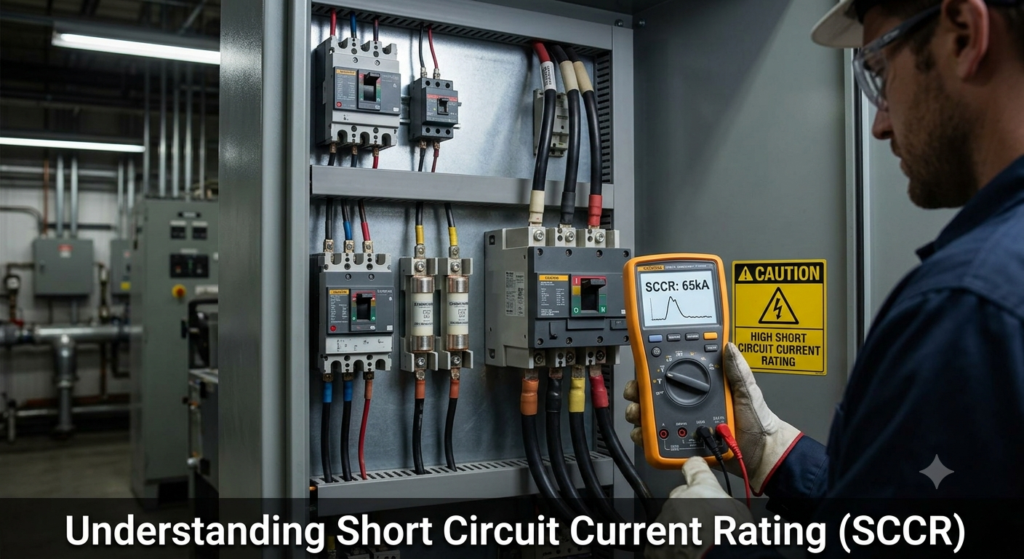
Short circuit current rating plays a direct role in how electrical systems perform under fault conditions. In commercial and industrial environments, it defines whether equipment can withstand the available fault current at its point of installation without sustaining damage.
In these environments, short circuit current rating is tied to safety, compliance, and operational continuity. A mismatch between available fault current and equipment rating can lead to equipment failure, arc flash events, or broader system disruption.
This article breaks down what short circuit current rating is, how it is determined, and how it applies in real-world facilities. It covers the code requirements, common challenges, and how to evaluate existing systems. At the end, you’ll have all the necessary knowledge about short circuit current analysis!
What is short circuit current rating?
Short circuit current rating (SCCR) defines the maximum fault current an electrical component or assembly can safely withstand at a given voltage. It is typically expressed in kiloamperes (kA) and applies to equipment such as panelboards, switchgear, and industrial control panels.
At its core, short circuit current rating is about withstanding fault conditions, not stopping them. When a short circuit occurs, electrical current rises sharply in a very short time. If the available fault current exceeds the equipment’s SCCR, the resulting thermal and mechanical stress can damage conductors, deform components, or lead to equipment failure.
In practice, SCCR must always be evaluated against the available fault current at the installation point. If the system can deliver more fault current than the equipment can handle, the installation does not meet code requirements and presents a safety risk.
Short circuit current rating vs interrupting rating (AIC)
Short circuit current rating is often confused with interrupting rating, also referred to as AIC. These are related but serve different purposes in an electrical system:
| Short circuit current rating (SCCR) | Interrupting rating (AIC) |
| Applies to equipment and assemblies (panels, switchgear, control panels) | Applies to protective devices (circuit breakers, fuses) |
| Withstand fault current without damage | Interrupt fault current safely |
| Protects equipment integrity | Protects circuit protection |
| Determined by the lowest-rated component in the assembly | Determined by device design and testing |
| Must be ≥ available fault current at the installation point | Must be ≥ available fault current at device terminals |
A common issue in the field is assuming that installing a high AIC breaker solves all fault current concerns. That is not the case. A breaker can interrupt a fault without the rest of the system being able to withstand the forces leading up to that interruption.
In practical terms, both values must be reviewed together. A system is only properly coordinated when the equipment SCCR and the protective device interrupting rating both exceed the available fault current at their respective locations.
Importance of short circuit current rating
Short circuit current rating directly affects how an electrical system behaves during a fault. In complex facilities, fault currents can reach high levels due to utility capacity, transformer sizing, and system configuration. If equipment is not rated for those conditions, the consequences are immediate.
When the available fault current exceeds the short circuit current rating, equipment can fail before protective devices clear the fault. This is where physical damage and safety risks begin. The impact is not limited to a single component and can extend across the system.
From a practical standpoint, short circuit current rating supports several key outcomes:
- Improves personnel safety: Properly rated equipment reduces the likelihood of arc flash events, equipment rupture, and exposure to high-energy faults.
- Protects equipment from catastrophic damage: Electrical components are more likely to withstand fault conditions without deformation, insulation failure, or internal destruction.
- Supports system reliability and uptime: Faults are more likely to be contained and cleared without escalating into broader system outages.
- Maintains code compliance: NEC requirements require equipment SCCR to meet or exceed available fault current at the installation point.
- Reduces operational and financial risk: Prevents avoidable downtime, emergency repairs, and potential insurance complications tied to non-compliant systems.
- Enables better system coordination: Helps align protective devices and equipment ratings so faults are managed predictably across the system.
In facilities where power continuity matters, these benefits are not theoretical. Short circuit current rating becomes a baseline requirement for operating safely and maintaining control over electrical risk.
How to determine short circuit current rating
Determining short circuit current rating requires understanding both the equipment and the electrical system it is connected to. After all, it’s the result of how components, protection, and available fault current interact.
Short circuit current rating is always evaluated against available fault current at the point of installation. That relationship drives whether the equipment is suitable for its location. The process typically involves both system analysis and equipment-level review.
Available fault current and why it matters
Available fault current is the maximum current that can flow during a short circuit at a specific point in the system. It depends on factors such as utility supply, transformer size, conductor impedance, and system layout.
The higher the available fault current, the higher the required short circuit current rating. This is why facilities with large service capacities or multiple transformers often face higher SCCR requirements.
Fault current is not constant across the system. It changes based on distance from the source and system configuration. That means each panel or piece of equipment must be evaluated at its specific location, not just at the service entrance.
The “weakest component” rule in assemblies
In assemblies like control panels or switchgear, SCCR is not based on the strongest component. It is based on the weakest one.
The overall short circuit current rating of an assembly is limited by its lowest-rated power circuit component. This includes items such as contactors, terminal blocks, bus bars, and overcurrent devices within the assembly.
If one component is rated at 10 kA while the rest are rated higher, the entire assembly may be limited to 10 kA unless protective measures are applied. This is a common issue in field-built or modified panels.
Role of current-limiting devices
Current-limiting devices, such as specific types of fuses and breakers, can reduce the amount of fault current that reaches downstream components.
These devices can increase the effective short circuit current rating of an assembly by limiting fault energy. Instead of allowing the full available fault current to pass through, they reduce the let-through current to a level the equipment can handle.
However, this only works when properly engineered and documented. Not all protective devices provide current-limiting behavior, and incorrect assumptions can lead to under-rated systems.
Step-by-step overview of SCCR calculation
While detailed calculations are typically handled by engineers, the overall process follows a clear structure:
- Identify all power circuit components: Start by mapping out every power-carrying component in the assembly. This includes breakers, fuses, contactors, overload relays, transformers, terminal blocks, and bus structures. Anything that carries fault current must be included in the evaluation. Control devices like push buttons or indicator lights are excluded, but anything tied to the power circuit matters.
- Determine individual component SCCRs: Each component must have a verified SCCR. This is typically found on the nameplate or in manufacturer documentation. If a component is not marked, UL 508A provides default values that must be used. Unmarked components do not default to “safe.” They often default to lower ratings, which can reduce the overall SCCR significantly.
- Evaluate branch circuits: Break the system into branch circuits and evaluate each one separately. Within each branch, identify the lowest-rated component. The branch circuit SCCR is always limited by its weakest component, not the average or highest-rated devices. This is where many assemblies lose rating without it being obvious.
- Apply current-limiting protection where applicable: If current-limiting fuses or breakers are used upstream, their let-through characteristics can reduce the fault current seen by downstream components. This can raise the effective SCCR, but only when based on tested and documented combinations. Assumptions or generic substitutions do not apply here. The specific device pairing matters.
- Establish the overall assembly SCCR: After evaluating all branches and applying any protective adjustments, compare the resulting values. The final short circuit current rating of the assembly is the lowest value across all branches after adjustments. This becomes the nameplate rating and the value used for code compliance.
In complex or aging facilities, this process is rarely straightforward. Equipment may have been modified, replaced, or expanded over time without a full reevaluation. That is where gaps between actual system conditions and labeled short circuit current rating tend to appear.
NEC requirements for short circuit current rating
The National Electrical Code sets the baseline for how short circuit current rating must be applied in electrical systems. These requirements focus on matching equipment ratings to actual system conditions and maintaining that alignment over time.
Several key NEC sections govern short circuit current rating:
- NEC 110.9 – Interrupting rating: Overcurrent protective devices must have an interrupting rating equal to or greater than the available fault current at their terminals.
- NEC 110.10 – Circuit impedance and equipment protection: The system must be designed so that faults are cleared without causing extensive damage to equipment. This ties directly to SCCR and system coordination.
- NEC 110.24 – Available fault current marking: Service equipment must be marked with the maximum available fault current and the date of calculation. This creates a direct reference point for comparing equipment short circuit current rating to real system conditions.
- NEC Article 409 – Industrial control panels: Industrial control panels must be marked with their short circuit current rating. They cannot be installed where the available fault current exceeds that rating.
For facility teams, NEC requirements establish a clear expectation. Equipment ratings, fault current calculations, and labeling must all align. When they do not, the issue becomes a compliance gap that needs to be addressed.
UL and industry standards that govern short circuit current rating
While the NEC defines where short circuit current rating must be applied, UL and other industry standards define how it is determined and validated. These standards provide the methodology behind SCCR calculations and equipment ratings used in real facilities.
UL standards establish how short circuit current rating is tested, calculated, and labeled for electrical equipment. They are the foundation for how manufacturers and engineers assign SCCR values to assemblies.
UL 508A requirements and SCCR calculation method
UL 508A is the primary standard for industrial control panels. It provides a structured method for determining SCCR at the assembly level, particularly when multiple components are involved.
UL 508A follows a component-based approach, where the lowest-rated power circuit component defines the overall SCCR unless adjustments are made. This aligns with the “weakest component” rule discussed earlier.
The standard also includes:
- Default SCCR values for unmarked components
- Guidelines for evaluating branch circuits within a panel
- Methods for increasing SCCR using current-limiting devices
- Requirements for documenting and labeling the final SCCR
This is especially relevant in field-built or modified panels, where components from different manufacturers are combined. Without a structured method like UL 508A, determining SCCR would be inconsistent and unreliable.
Role of NETA, IEEE, and NFPA standards
Beyond UL, several other organizations influence how short circuit current rating is evaluated in practice.
- NETA (InterNational Electrical Testing Association): Provides standards for acceptance and maintenance testing. These help verify that equipment performs as expected under real operating conditions.
- IEEE (Institute of Electrical and Electronics Engineers): Publishes methodologies for short circuit studies and system modeling. These are used to calculate available fault current across a facility.
- NFPA (National Fire Protection Association): Standards such as NFPA 70E and NFPA 70B focus on electrical safety and maintenance. While they do not define SCCR directly, they rely on accurate system data, including fault current levels.
Together, these standards connect design, calculation, testing, and maintenance. SCCR sits within a broader framework that includes system studies, safety practices, and ongoing verification.
In complex facilities, especially those operating continuously, these standards are often applied together. This is where a maintenance-led approach becomes relevant. When systems are regularly tested and reviewed against these standards, gaps in short circuit current rating and fault current alignment are more likely to be identified before they lead to larger issues.
How to evaluate short circuit current rating in an existing facility
Evaluating short circuit current rating in an existing facility requires both field verification and system-level analysis. Many facilities have equipment installed over different phases, often with varying documentation quality.
The goal is to confirm that the equipment short circuit current rating is aligned with the available fault current at each location. This process identifies gaps that may not be visible during normal operation:
Where to find SCCR on equipment
SCCR is typically marked on the equipment nameplate or inside the panel. For industrial control panels, it may also appear on wiring diagrams or manufacturer documentation.
Common locations include:
- Panel doors or interior labels
- Manufacturer specification sheets
- Equipment submittals or as-built drawings
If SCCR cannot be clearly identified, it should not be assumed. Missing information often requires further evaluation or recalculation based on installed components.
How to verify available fault current
The available fault current must be calculated or confirmed through an engineering study. This involves analyzing:
- Utility service capacity
- Transformer sizes and impedance
- Conductor lengths and configurations
- System layout and protective devices
This data is used to determine fault current at different points in the system. Available fault current is location-specific and must be compared directly to the equipment SCCR at each point.
In facilities with existing studies, this information may already be documented. However, it must be reviewed for accuracy, especially if the system has changed.
When is a study or engineering review needed?
Not every facility has up-to-date fault current data. A study or engineering review is typically needed when:
- System modifications have been made
- Equipment has been added or replaced
- Documentation is missing or outdated
- Compliance or insurance reviews are underway
If there is uncertainty about fault current levels or equipment ratings, a formal short circuit study is required to establish accurate values. In live environments, this type of work requires coordination. Systems often cannot be taken offline, so evaluations must be performed with minimal disruption.
What to do if equipment is under-rated
If the equipment SCCR is lower than the available fault current, the issue must be addressed. This is a compliance and safety concern.
Typical options include:
- Replacing equipment with higher SCCR-rated components
- Adding current-limiting devices upstream
- Reconfiguring the system to reduce fault current exposure
The appropriate solution depends on the system design, available space, and operational constraints. In active facilities, changes must be planned carefully to avoid unnecessary downtime.
For facilities that operate continuously, this is where experience in live-system work becomes important. Evaluating and addressing SCCR gaps often requires coordination between engineering, maintenance, and operations teams to implement changes safely while maintaining ongoing operations.
Short circuit current rating and insurance requirements
Short circuit current rating is not always addressed directly in insurance policies, but it plays a clear role in how electrical risk is evaluated. Insurers assess the likelihood of equipment failure, fire, and business interruption. Fault current exposure is part of that evaluation.
If equipment short circuit current rating does not align with available fault current, it increases the perceived risk profile of the facility. This can affect underwriting decisions, policy terms, and how claims are reviewed after an incident.
From an underwriting perspective, insurers often look for:
- Evidence of up-to-date electrical studies
- Proper equipment labeling and documentation
- Maintenance records tied to recognized standards
- Compliance with NEC and NFPA guidelines
These factors help establish whether the electrical system is being actively managed or left to degrade over time.
There is also a claims-side consideration. If an electrical failure occurs and equipment is found to be under-rated for the available fault current, it can raise questions about compliance and maintenance practices. This does not automatically determine claim outcomes, but it becomes part of the investigation.
When to involve a qualified electrical contractor
Short circuit current rating is not always straightforward to evaluate in the field. In many facilities, system documentation is incomplete, equipment has been modified over time, and fault current levels are not clearly defined. So, when do you know that an electrical contractor needs to step in?
Here are some of the signs you need a qualified electrical contractor:
- After major system changes
- During compliance reviews or audits
- When equipment labeling is unclear or absent
- Following electrical incidents or near-misses
- When planning system expansions or retrofits
In these scenarios, the scope of work typically includes fault current calculations, equipment evaluation, and recommendations for corrective action. In more complex facilities, this may also involve coordination with arc flash studies and protective device settings.
This is where C&H Electric can step in and take care of your complex facility. Our experts are licensed individuals who work with compliance, insurance requirements, and your facility’s unique needs in mind to conduct short-circuit current analysis and protect your electrical system from staggering.
Reach out to us today and get connected with professionals who know exactly what your system needs!