
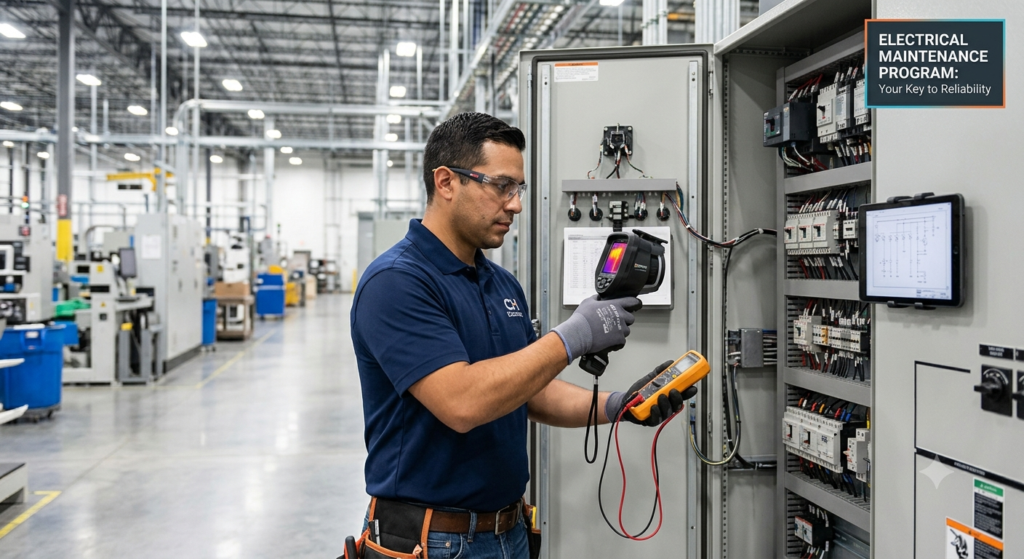
In many facilities, electrical systems are only addressed when something goes wrong. A panel overheats, a breaker trips, or equipment starts behaving inconsistently. By that point, the issue has already developed over time.
For organizations that depend on continuous power, such as healthcare facilities, electrical maintenance is directly tied to operational continuity. Unplanned failures are often the result of missed maintenance, not sudden defects. A formal program helps reduce that exposure by combining routine inspections with targeted testing and condition-based analysis.
This article breaks down what an electrical maintenance program includes, how it is structured, and which standards shape it. It also covers how often maintenance should be performed, what common gaps to avoid, and how facility teams can build or improve a program that aligns with safety requirements and long-term asset performance.
What is an electrical maintenance program?
An electrical maintenance program is a structured process for inspecting, testing, and maintaining electrical systems to support safe and reliable operation. It defines how equipment is monitored, how often maintenance is performed, and how results are documented.
These programs combine preventive, predictive, and corrective activities to identify issues early and manage risk. In commercial facilities, they are often aligned with standards such as NFPA 70B and OSHA requirements.
Benefits of a structured electrical maintenance program
A structured electrical maintenance program gives facility teams a clear framework for managing risk, performance, and compliance. Instead of reacting to failures, maintenance becomes planned, documented, and aligned with how the system is actually used.
Here are the top 3 benefits facilities can get from building a structured electrical maintenance program:
Reduced downtime and operational risk
Unplanned outages are rarely random. They are often linked to deteriorating components, loose connections, or overlooked testing intervals. A structured maintenance program addresses these issues before they escalate.
Routine inspections and diagnostic testing help detect failure conditions early. This includes identifying overheating connections, insulation breakdown, or mechanical wear in breakers and switchgear. When these issues are found in advance, repairs can be scheduled instead of forced by failure.
In mission-critical environments, this approach becomes even more important. Facilities that operate continuously cannot rely on reactive maintenance. Programs that combine preventive and predictive methods allow teams to manage risk without interrupting operations.
Improved safety and compliance
Electrical systems carry inherent safety risks, especially in energized environments. A structured program aligns maintenance activities with established safety standards and regulatory requirements.
Standards such as NFPA 70B, NFPA 70E, and OSHA regulations define how maintenance should be performed and documented. Following these frameworks helps reduce exposure to arc flash incidents, shock hazards, and non-compliance findings during inspections or audits.
Clear procedures also support safer work practices. This includes lockout/tagout protocols, proper PPE usage, and documented training for qualified personnel. In facilities where work is performed on live systems, structured safety processes are not optional. They are part of daily operations.
Better asset lifespan and performance
Electrical equipment degrades over time. Heat, load conditions, and environmental factors all contribute to wear. Without maintenance, this degradation accelerates and leads to early replacement or failure.
Regular servicing and testing help extend the usable life of critical assets such as transformers, breakers, and switchgear. Cleaning, tightening, lubrication, and calibration all play a role in maintaining performance.
There is also a financial impact. Planned maintenance spreads costs over time, while emergency repairs often come with higher labor, downtime, and replacement expenses. For facilities managing aging infrastructure, a structured program provides a more predictable path for maintaining performance and planning capital upgrades.
Many of these benefits depend on how well the program is structured and executed. In high-risk environments, C&H Electric supports facilities by identifying gaps in existing maintenance practices and implementing programs designed around system criticality and real operating conditions.
What is included in an electrical maintenance program?
An electrical maintenance program is built around a defined set of activities that cover inspection, testing, servicing, and documentation. These elements work together to give a clear picture of system condition and performance over time. Without this structure, maintenance tends to become reactive and inconsistent.
At a practical level, the program outlines what gets checked, how often it is evaluated, and how results are recorded:
Inspection procedures
Inspection is the first layer of any maintenance program. It focuses on identifying visible or measurable signs of deterioration before they develop into faults.
Routine inspections typically include both visual checks and basic mechanical verification. This may involve looking for loose connections, corrosion, overheating indicators, or physical damage to equipment enclosures and components.
Common inspection points include:
- Discoloration or heat damage on conductors and terminations
- Signs of moisture ingress or contamination
- Condition of insulation and cable routing
- Panel labeling and accessibility
In live facilities, inspections are often performed with minimal disruption. This makes them a practical way to monitor system health between more intensive testing intervals.
Testing requirements
Testing goes beyond what inspections can reveal. It uses instruments and calibrated methods to evaluate how equipment performs under real or simulated conditions.
Electrical testing is used to detect hidden issues such as insulation breakdown, contact resistance, and abnormal load behavior. These conditions are not always visible but can lead to failure if left unaddressed.
Typical testing methods include:
- Infrared thermography for heat detection
- Ultrasonic testing for arcing and tracking
- Insulation resistance testing
- Circuit breaker trip testing
- Power quality analysis
Testing frequency depends on equipment type, criticality, and applicable standards such as NFPA 70B or NETA MTS. These testing methods require specialized equipment and experienced personnel to interpret results correctly. C&H Electric performs advanced diagnostics in live facility environments, helping teams identify hidden risks without disrupting operations.
Preventive maintenance tasks
Preventive maintenance involves hands-on servicing of electrical equipment to maintain performance and reduce wear. These tasks are usually scheduled at defined intervals.
Common activities include cleaning, tightening, lubrication, and calibration of components. While these may seem basic, they directly affect how equipment performs under load and over time.
Examples of preventive tasks:
- Torqueing electrical connections to manufacturer specifications
- Cleaning dust and debris from switchgear and panels
- Lubricating moving parts in breakers and disconnects
- Replacing worn or aging components
In facilities with aging infrastructure, preventive work often plays a key role in extending asset life and avoiding premature replacement.
Documentation and reporting
Documentation ties the entire electrical maintenance program together. It provides a record of what was done, what was found, and what actions were taken.
Accurate documentation is essential for compliance, audits, and long-term planning. It also allows teams to track trends, compare results over time, and identify recurring issues.
Key documentation elements include:
- Maintenance logs and service reports
- Test results and condition assessments
- Equipment inventory and maintenance history
- Records of corrective actions and follow-up work
For organizations managing multiple facilities or complex systems, consistent reporting creates a clearer view of system health and supports more informed operational decisions.
Types of electrical maintenance programs
Not all electrical maintenance programs follow the same approach. The structure and methods used depend on the facility, the criticality of the systems, and how risk is managed. Most programs combine multiple maintenance strategies rather than relying on a single method.
Each type of maintenance addresses a different stage of equipment life and failure risk. Understanding how they work together is key to building a balanced and effective program.
Preventive maintenance
Preventive maintenance is the most common approach. It is based on performing maintenance tasks at scheduled intervals, regardless of equipment condition.
This method focuses on reducing the likelihood of failure through routine servicing and inspections. Tasks are typically planned using manufacturer guidelines, industry standards, or internal schedules.
Examples include:
- Annual breaker testing
- Scheduled transformer inspections
- Routine cleaning and tightening of connections
Preventive maintenance works well for standard equipment, but it may lead to unnecessary work if intervals are not adjusted based on actual usage or condition.
Predictive maintenance
Predictive maintenance uses data and diagnostic tools to determine when maintenance is actually needed. Instead of relying only on schedules, it tracks the condition of equipment over time.
This approach identifies early signs of failure through techniques like thermography, ultrasonic testing, and power analysis. Maintenance is then performed based on measured conditions rather than fixed timelines.
Typical indicators used in predictive maintenance:
- Temperature anomalies
- Vibration or sound irregularities
- Electrical load imbalances
- Insulation degradation trends
In mission-critical environments, predictive methods are often layered into preventive programs to reduce unnecessary downtime and focus resources where they are needed most.
Corrective maintenance
Corrective maintenance is performed after a problem has been identified. This could be during an inspection, through testing, or after a failure has occurred.
This approach addresses known issues, but on its own, it is reactive and carries higher operational risk. It is still an essential part of any maintenance program, as not all issues can be predicted in advance.
Examples include:
- Replacing a failed breaker
- Repairing damaged insulation
- Addressing overheating connections found during inspection
Facilities that rely heavily on corrective maintenance often experience higher downtime and less predictable costs.
Key standards that shape an electrical maintenance program
An electrical maintenance program is not built in isolation. It is shaped by established standards and regulatory frameworks that define how maintenance should be performed, documented, and evaluated.
These three standards provide consistency across facilities and set expectations for safety:
NFPA 70B and its role in maintenance planning
NFPA 70B is one of the most important references for electrical maintenance. It outlines recommended practices for maintaining electrical equipment and has recently evolved into a standard rather than just a guideline.
NFPA 70B provides detailed guidance on maintenance intervals, inspection methods, and testing procedures for electrical systems. It covers a wide range of equipment, including switchgear, transformers, and protective devices.
Key areas addressed by NFPA 70B include:
- Suggested maintenance frequencies based on equipment type
- Inspection and testing procedures
- Documentation and recordkeeping practices
- Condition-based maintenance considerations
The shift toward enforceable language in recent updates means facilities are expected to take a more structured approach to maintenance planning.
OSHA requirements for electrical safety
OSHA regulations focus on workplace safety rather than equipment performance. However, they directly influence how maintenance is carried out in any electrical maintenance program.
OSHA standards require employers to protect workers from electrical hazards such as shock, arc flash, and arc blast. This includes enforcing safe work practices and proper use of protective equipment.
Relevant OSHA requirements include:
- Lockout/tagout procedures under 29 CFR 1910.147
- Electrical safety requirements under 29 CFR 1910 Subpart S
- Construction-related electrical safety under 29 CFR 1926 Subpart K
Maintenance programs must account for these requirements by integrating safety procedures into all inspection and testing activities.
NETA testing standards (MTS and ATS)
NETA standards focus specifically on electrical testing. They define how acceptance testing and ongoing maintenance testing should be performed.
NETA MTS (Maintenance Testing Specifications) provides detailed procedures for evaluating the condition of electrical equipment in service. It is widely used for periodic testing programs.
NETA ATS (Acceptance Testing Specifications) applies to new installations and verifies that equipment is installed and functioning correctly before being placed into service.
Key contributions of NETA standards include:
- Standardized testing methods and procedures
- Defined test values and acceptable ranges
- Reporting formats for consistent documentation
For facilities that rely on accurate diagnostics, NETA standards add a level of technical depth that complements NFPA and OSHA requirements.
Core components of an effective electrical maintenance program
An effective electrical maintenance program is more than a list of tasks. The strength of a program depends on how well these components work together. Gaps in one area, such as asset tracking or scheduling, often affect the entire maintenance process.
Below is a breakdown of the key components that support a structured and reliable program:
| Component | What it involves | Why it matters |
| Asset inventory and system mapping | Documenting all electrical equipment, including ratings, locations, and system relationships | Provides visibility into what needs to be maintained and how systems are interconnected |
| Maintenance intervals and scheduling | Defining when inspections, testing, and servicing occur | Creates consistency and prevents missed maintenance activities |
| Safety procedures and LOTO | Establishing lockout/tagout protocols and safe work practices | Reduces risk during maintenance and aligns with OSHA requirements |
| Arc flash risk assessment and labeling | Evaluating incident energy levels and labeling equipment accordingly | Supports safe work planning and compliance with NFPA 70E |
| Training and qualification of personnel | Ensuring staff are trained to perform electrical work safely and correctly | Improves execution quality and reduces human error |
How to build an electrical maintenance program step by step
Building an electrical maintenance program requires a structured approach. It starts with understanding the system and ends with continuous review and improvement. Skipping steps often leads to gaps in coverage, inconsistent execution, or incomplete documentation.
A strong program is built in stages, with each step informing the next. This makes it easier to scale across facilities and maintain consistency over time:
Step 1: Assess existing electrical infrastructure
The first step is to understand what equipment is in place and how it is configured. This includes identifying all major assets and how they connect within the distribution system.
A complete and accurate asset inventory is the foundation of the entire program. Without it, maintenance activities cannot be planned effectively.
This assessment typically includes:
- Equipment type, rating, and location
- Single-line diagrams and system layout
- Age and condition of assets
- Criticality of each component
Facilities with incomplete or outdated records often need to start by rebuilding this information. For many facilities, this initial assessment is where external support becomes valuable. C&H Electric works directly with facility teams to map electrical systems, identify critical assets, and establish a clear foundation for long-term maintenance programs.
Step 2: Define maintenance scope and priorities
Once the system is mapped, the next step is defining what will be maintained and at what level of detail.
Not all equipment requires the same level of attention. Prioritization should be based on risk and operational impact. Critical systems that support continuous operations are typically addressed first.
This step involves:
- Identifying high-risk and mission-critical assets
- Determining which maintenance activities apply to each asset
- Aligning scope with applicable standards and internal policies
In facilities that operate live systems, scope definition also considers how maintenance can be performed without disrupting operations.
Step 3: Establish maintenance intervals
With scope defined, maintenance intervals can be set. These intervals should balance standard guidelines with real-world operating conditions.
Intervals should combine time-based schedules with condition-based adjustments where possible. This creates a more flexible and accurate maintenance plan.
Inputs used to define intervals include:
- Manufacturer recommendations
- NFPA 70B guidance
- Equipment usage and load conditions
- Historical maintenance and failure data
Over time, intervals can be refined as more data becomes available.
Step 4: Implement testing and inspection procedures
At this stage, the program moves from planning to execution. Specific procedures are established for inspections, testing, and servicing.
Standardized procedures improve consistency and make results easier to compare over time. They also support compliance with testing standards such as NETA MTS.
Key elements include:
- Defined inspection checklists
- Testing methods and acceptance criteria
- Required tools and instrumentation
- Safety procedures integrated into each task
For facilities with complex systems, these procedures are often documented in detail to support repeatability. C&H Electric can help you with testing your live facility and aid with inspection procedures. Our experts conduct infrared thermography, breaker testing, switchgear maintenance and beyond to keep your facility compliant, safe, and working without hitting roadblocks.
Step 5: Create documentation and tracking systems
Documentation is what turns maintenance activities into a program. Without it, there is no reliable record of what has been done or what needs attention.
Tracking systems provide visibility into equipment condition, maintenance history, and upcoming tasks. This supports better decision-making and audit readiness.
Common tools include:
- Maintenance management systems (CMMS)
- Digital inspection and testing reports
- Equipment lifecycle tracking
- Scheduled maintenance calendars
Consistent documentation also helps identify trends and recurring issues. At C&H Electric, we help our customers build a compliant set of documentation that turns their maintenance activities into a resourceful program. If you need help creating such documentation, reach out to us today and get started!
Step 6: Review and update the program regularly
An electrical maintenance program is not static. It needs to be reviewed and adjusted as equipment ages, loads change, and new standards are introduced.
Regular reviews help identify gaps, update intervals, and refine maintenance strategies. This keeps the program aligned with current operating conditions and compliance requirements.
Review cycles often include:
- Evaluating maintenance results and test data
- Updating asset condition assessments
- Adjusting intervals based on performance trends
- Incorporating changes from updated standards such as NFPA 70B
In long-term maintenance partnerships, this continuous improvement process is what keeps the program effective over time.
When to outsource an electrical maintenance program
Not every facility has the internal resources to manage a full electrical maintenance program. As systems become more complex and standards evolve, many organizations choose to outsource part or all of their maintenance activities to specialized providers.
But how do you know you should outsource? There are several indicators that outsourcing may be the right move:
- Limited in-house expertise for testing, diagnostics, or compliance
- Inconsistent maintenance schedules or incomplete documentation
- Lack of access to specialized tools such as infrared cameras or testing equipment
- Increasing regulatory or insurance requirements
In these cases, external providers bring structured processes and technical capabilities that may not be practical to maintain internally.
With decades of experience in mission-critical environments, C&H Electric focuses on electrical systems where failure has real consequences. That includes healthcare facilities, industrial operations, and institutional campuses that cannot afford extended downtime.
C&H Electric’s approach is built around maintenance and compliance-first framework. That distinction matters. Maintenance-led teams are structured to identify issues early, prioritize based on risk, and work within active facilities without disrupting operations.
Maintenance activities are documented, tracked, and structured in a way that supports audits, inspections, and insurance expectations. If that is your priority, reach out to us and we’ll help you get started with the best foot forward.
Conclusion
An electrical maintenance program provides structure to activities that would otherwise be reactive and inconsistent. It supports safety, compliance, and operational reliability across commercial and institutional facilities.
Facility managers should begin by evaluating their current maintenance practices, identifying gaps in testing, documentation, and scheduling. From there, the focus shifts to building a program that aligns with standards and reflects the operational demands of the facility.
For organizations managing complex electrical systems, partnering with an experienced contractor like C&H Electric can help establish a program that is practical, compliant, and aligned with long-term performance goals.