
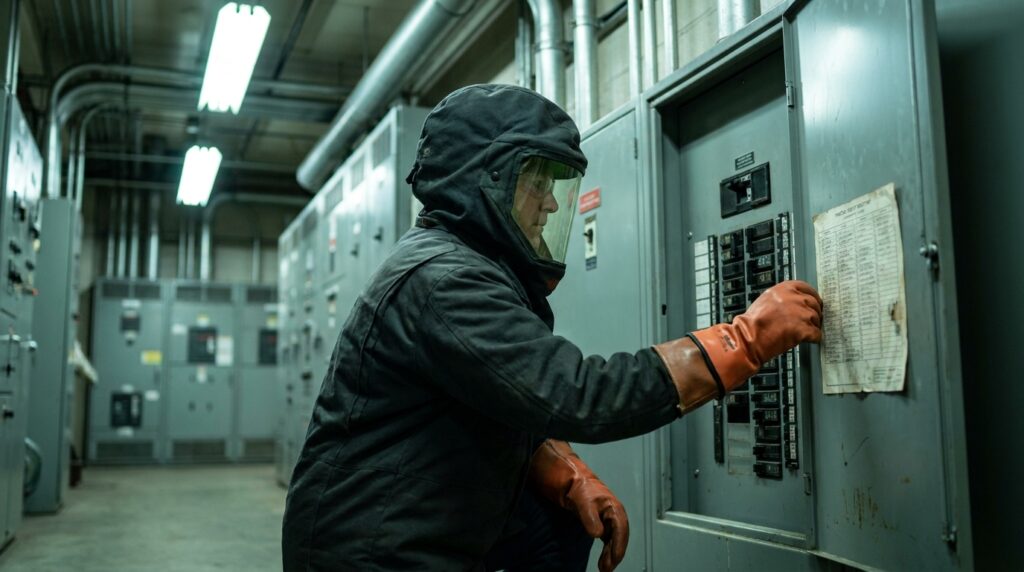
A directory that says “spare” on a breaker that’s actually live doesn’t just fail an inspection. It fails the technician who opens it believing the circuit is dead. Panel schedule compliance gets treated as paperwork because most of the time nothing goes wrong when it’s out of date — until the one time someone needs it to be right and it isn’t.
This article breaks down what panel schedule compliance actually requires under the NEC, why an inaccurate directory is a safety problem and not only a compliance one, and what it costs a facility to let documentation drift for years instead of maintaining it as circuits change. It covers NEC 408.4(A), why legibility and access are where directories fail most often, and how digitizing panel schedules removes the friction that lets documentation drift in the first place, letting a technician update one from a phone, tablet, or desktop the moment a circuit changes.
What Is Panel Schedule Compliance?
Panel schedule compliance means the circuit directory on every panelboard, switchboard and switchgear in a facility accurately and legibly identifies what each circuit feeds, as required by NEC 408.4(A). It’s a narrower thing than it sounds. Compliance isn’t a directory that exists — plenty of out-of-date directories exist. It’s a directory a qualified person can trust enough to act on without independently re-verifying it first, which is the entire point of having one.
That distinction matters because a directory that’s present but wrong is worse in practice than no directory at all. A missing directory tells a technician to go find out what a circuit feeds before they touch it. A wrong one tells them they already know — and they usually believe it.
What Panel Schedule Compliance Involves
Meeting the requirement means two things have to be true at the same time: the directory has to be accurate, and it has to be legible and available to whoever is standing in front of the panel. Facilities usually fail on the second one first.
- The circuit directory (NEC 408.4(A)). Identifies what each circuit or breaker position feeds, in specific enough language that nothing depends on who currently occupies the space. For a panelboard, it lives on the face of the panel, inside the door, or in an approved location next to it. For a switchboard or switchgear, the identification sits at each individual switch or breaker rather than in one centralized sheet.
- Legibility and access. A directory can be technically accurate and still useless — handwritten, water-stained, layered with crossed-out entries, or filed in a binder in the maintenance office instead of at the equipment. This is where a digitized panel schedule earns its keep: one authoritative record that stays typeset and readable no matter how many times it’s revised, reachable from a phone, tablet, or desktop at the panel, and printable for the panel door whenever the physical copy needs refreshing.
Both halves matter. An accurate directory nobody can read is a directory nobody uses, and a perfectly legible one that’s three years behind the panel is worse than none at all — it tells a technician they already know what a breaker feeds.
Why Panel Schedule Compliance Matters: Compliance and Cost
An out-of-date panel schedule is a code violation on its own, independent of whether the wiring behind it is actually safe, and it gets more expensive to fix the longer it’s ignored. An inspector or insurer doesn’t need to find a hazard to write up a stale directory — the directory itself not matching the panel is the finding.
The cost side compounds quietly. Updating a directory at the time of a circuit change takes a label maker and a few minutes. Reconstructing one years later, for an entire panel or an entire facility, means tracing circuits with a toner and receiver one at a time, coordinating with every affected department before a breaker can be switched, and scheduling a shutdown window for anything that can’t be traced safely energized. None of that scales the way updating one circuit at a time does. A directory kept current breaker-by-breaker never turns into a facility-wide tracing project: it’s easier to stay ready than to get ready.
The Safety Case: What a Wrong Directory Actually Costs
A mislabeled circuit directory isn’t just an audit finding — it’s a live hazard the moment someone acts on it, because lockout/tagout and emergency response both depend on the directory being right the first time, not eventually. This is the part a compliance-only framing misses, and it’s the part that should worry a facility manager more than the citation.
Consider what a lockout/tagout procedure actually assumes. OSHA’s control-of-hazardous-energy standard, 29 CFR 1910.147, requires isolating and verifying the absence of energy before work begins on equipment — and identifying the correct disconnect is the step that comes before any of that verification can happen. A technician who locks out the breaker the directory labels “HVAC — Roof 3” because that’s the equipment they’re servicing has no reason to suspect the label is wrong. If the directory hasn’t been updated since a tenant fit-out three years ago and that breaker now actually feeds a process line one floor down, the technician has isolated the wrong circuit and may proceed to work on equipment they believe is de-energized. Voltage testing at the point of work is supposed to catch exactly this, but it’s a backstop for human error, not a substitute for a directory a crew can trust in the first place — and under time pressure, backstops get skipped.
Emergency response is less forgiving still. A facility team or first responder killing power to a specific area during a fire, a flood, or a medical emergency is working from the directory, often reading it for the first time under stress. A directory that lies sends them to the wrong breaker — either leaving the actual hazard energized, or de-energizing equipment that shouldn’t go dark in the middle of an emergency, like life-safety loads in a hospital or a data center’s cooling system. This is the scenario a “we’ll get to it” attitude toward panel schedules doesn’t account for: the directory isn’t consulted casually. It’s consulted at the exact moment when being wrong does the most damage.
Standards and Compliance
Panel schedule compliance rests on one requirement in the NEC. The harder question is operational: how a facility keeps that documentation accurate and readable as circuits change.
NEC 408.4(A) — the circuit directory requirement
NEC 408.4(A) is the core requirement, and its own wording rules out the kind of directory most facilities actually have. The 2023 NEC states it plainly:
“Every circuit and circuit modification shall be legibly identified as to its clear, evident, and specific purpose or use. The identification shall include an approved degree of detail that allows each circuit to be distinguished from all others. Spare positions that contain unused overcurrent devices or switches shall be described accordingly. The identification shall be included in a circuit directory that is located on the face, inside, or in an approved location adjacent to the panel door in the case of a panelboard, and at each switch or circuit breaker in a switchboard or switchgear. No circuit shall be described in a manner that depends on transient conditions of occupancy.”
Three things follow directly. “Spare” is an acceptable, specific label for an unused breaker — the code names it. The directory has to live in a defined, findable location, which differs by equipment type as quoted above. And the last sentence prohibits exactly the directory most facilities have: one built around a tenant name or a department that will eventually move out, at which point the directory becomes noncompliant the moment the org chart changes, not just inaccurate.
“Legibly identified” — the requirement most directories actually fail
408.4(A) doesn’t only require identification; it requires legible identification, located where the person working on the equipment can find it. A sheet carrying three generations of handwriting, crossed-out entries, and initials nobody recognizes fails that test even if every circuit on it happens to be correct. Legibility is not a housekeeping preference in the code — it’s the operative word in the sentence.
This is the practical argument for digitizing the schedule rather than maintaining it in pen. A digital record stays typeset and readable through any number of revisions, keeps one version everyone is working from instead of a panel copy and an office copy that disagree, retains a history of who changed what and when, and can be viewed from a phone, tablet, or desktop right at the equipment.
How Often Should a Panel Schedule Be Updated?
There’s no periodic review interval for a circuit directory — the obligation is continuous, triggered by every circuit change, not a calendar date. That’s a harder standard to plan around than a fixed interval, which is exactly why it gets missed. It’s also why the update has to be effortless: if recording a change means walking back to the office to find the master spreadsheet, it won’t happen on the day the work is done, and the day the work is done is the only day it’s reliable.
| Trigger | Action required | Notes |
| Any circuit added, removed, or reassigned | Update the directory immediately | Per 408.4(A); not deferrable to the next PM visit |
| Tenant, department, or occupancy change | Re-verify and relabel affected circuits | The code specifically prohibits occupancy-based descriptions |
| New panel or panel replacement | Build the directory as part of commissioning | Confirm it before energizing, not after |
| Routine audit | Annually, cross-checked against as-built drawings | Not required by 408.4(A) directly, but the practical way to catch drift the trigger-based rule misses |
| Change made in the field | Log it the same day, from a phone, tablet, or desktop | A digitized schedule lets the person who made the change record it on the spot |
If it’s been more than a couple of years since your panel schedules were checked against what’s actually installed, have C&H verify them during your next scheduled maintenance visit rather than waiting for an inspector, an insurer, or an emergency to find the gap first.
Common Challenges in Keeping Panel Schedules Compliant
Most panel-schedule problems are logistical rather than technical — they accumulate through normal facility turnover, not through any single mistake.
Legacy facilities with years of undocumented changes
Older buildings often have panels that have been modified dozens of times since original construction, with no directory update tracking any of it. By the time someone notices, tracing every circuit from scratch is a scoped project in its own right, not something that fits into routine maintenance time.
Tenant and department turnover
Multi-tenant and multi-department facilities are the fastest-drifting case, because the directory’s accuracy depends on who currently occupies a space, and that information changes on a lease or reorg cycle the electrical documentation never hears about.
Access and downtime for verification
Confirming a directory against reality sometimes requires switching a breaker to see what goes dark, which means coordinating with whoever’s downstream of it first. In a facility that runs continuously, finding that window is its own scheduling problem, separate from the labeling work itself.
Misconceptions About Panel Schedule Compliance
A few persistent assumptions lead facilities to under-invest in panel documentation even when the rest of their electrical maintenance program looks solid.
“If it’s handwritten inside the door, that’s good enough”
Pen inside the panel door is how most directories start and why most of them end up unusable. Every change adds another layer of ink in another person’s handwriting, and within a few years the sheet documents its own edit history rather than stating what each breaker feeds. A digitized schedule keeps one authoritative version that stays legible however many times it changes, records who updated what and when, and prints cleanly for the door whenever the physical copy needs replacing.
“It was accurate when the building was occupied”
A directory that was correct at move-in and never touched since is not compliant — it’s compliant history. NEC 408.4(A) explicitly bars descriptions tied to who currently occupies a space precisely because that condition doesn’t hold indefinitely.
“This is a paperwork problem, not a safety one”
Treating panel schedule accuracy as clerical rather than operational is the misconception that does the most damage, because it’s the one that gets deprioritized until a lockout/tagout procedure or an emergency response depends on the directory being right, as described above.
Recent Trends in Panel Schedule Documentation
Facilities are starting to treat panel documentation as a live operational record rather than a one-time deliverable filed away after commissioning.
Digital, versioned directories
More facilities are replacing the printed sheet taped inside the panel door with a digital record that’s updated the same day a circuit changes, reducing the lag between a physical change and the documentation catching up to it — the lag where most compliance and safety gaps actually live.
Updates made from the field, not the office
The bigger shift isn’t the format, it’s who can make the change. When the schedule lives in a system reachable from a phone, tablet, or laptop, the electrician or facilities tech who just reassigned a circuit records it before leaving the room, instead of adding it to a list of things to document later that nobody gets back to. Removing that friction is what turns “update it at the time of the change” from a policy into something that actually happens.
Risk-based audit scheduling
Facilities are prioritizing directory audits for the panels that carry the most consequence if wrong, such as life-safety circuits, production lines, and anything a lockout/tagout procedure would touch first, rather than auditing every panel on the same flat schedule.
How to Build a Panel Schedule Compliance Program
A compliant panel schedule is the output of a maintained process, not a project you finish once.
- Update the directory at the time of any circuit change, not on the next inspection cycle. This is what 408.4(A) actually requires, and it’s the single habit that prevents the rest of this list from ever becoming necessary.
- Digitize the schedule so an update can be made at the panel from a phone, tablet, or desktop. Removing the friction is what makes step 1 realistic instead of aspirational.
- Give every trade that touches a panel access to the record, so the person who makes the change is the person who logs it.
- Prioritize verification on the panels a lockout/tagout procedure or emergency response would touch first, such as life-safety loads and critical process equipment, over a flat, alphabetical audit schedule.
- If directories have drifted for years, scope reconstruction as its own project with a shutdown window, rather than squeezing it into routine PM time where it will keep losing to higher-priority work.
Final Thoughts
Panel schedule compliance gets filed under paperwork because most days, an out-of-date directory costs nothing visible. That’s exactly what makes it dangerous: the day it costs something is the day a technician locks out the wrong circuit or an emergency responder kills power to the wrong space, and by then the citation is the least of anyone’s problems. Treating the directory as a live safety document, digitized so it stays legible, updated from the field the day a circuit changes, and prioritized by consequence rather than convenience, is what keeps a facility from finding out the hard way that its panel schedule was wrong.