
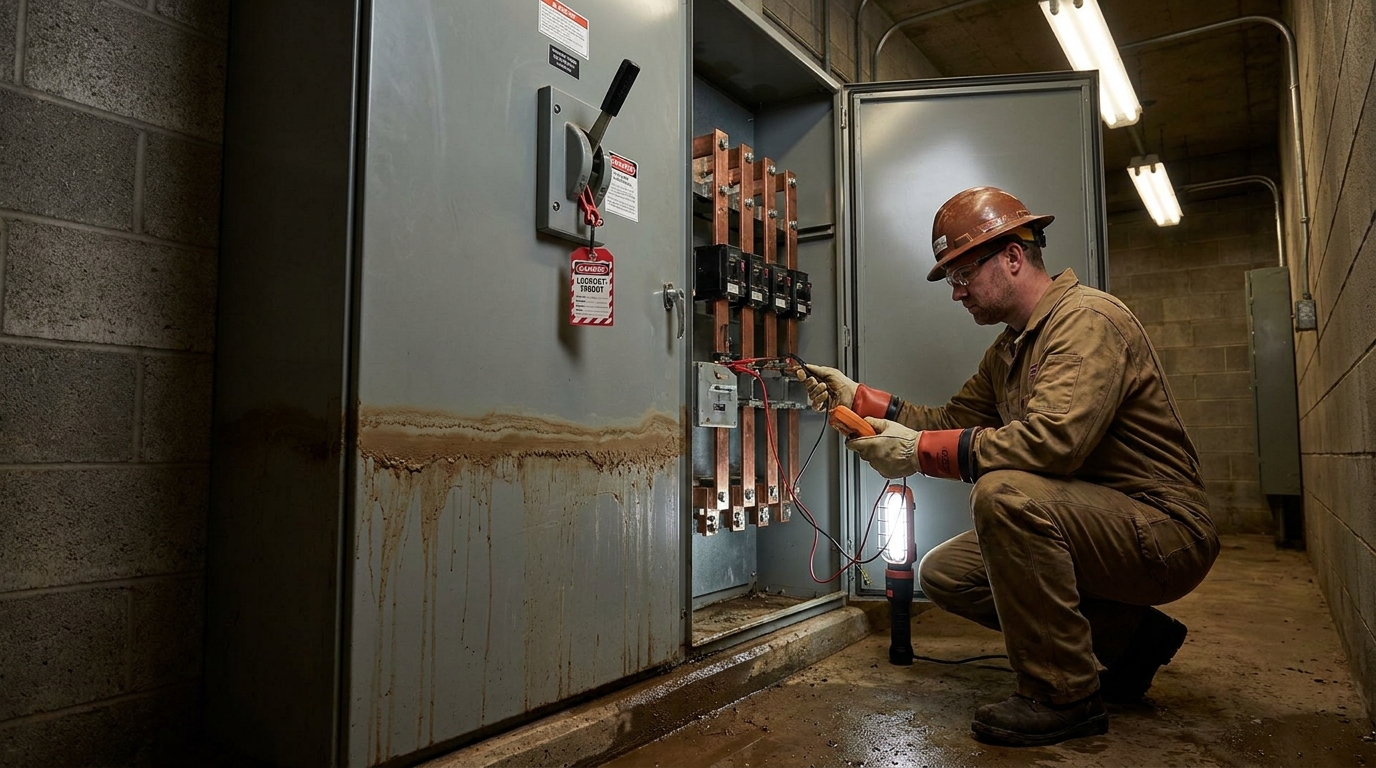
Water finds the lowest point in a building, and in most commercial and industrial facilities that is exactly where the electrical service equipment sits. A panel or switchgear lineup that looks fine once the water recedes and the room dries out can still be carrying corrosion, contaminated insulation, or a trip unit that will not open under fault conditions. Re-energizing on the assumption that “it looks okay” is how a flood cleanup turns into an electrical fire or a shock incident weeks later.
This article covers how to de-energize and assess flood-affected equipment safely, when the utility needs to be involved before anyone else touches anything, what tests different types of equipment actually need, and how to tell what can be reconditioned from what has to be replaced.
What should you test before re-energizing electrical equipment after a flood?
Before any flood-affected equipment goes back into service, it needs a visual inspection for water and contamination, insulation resistance and dielectric testing appropriate to the equipment type, and a documented decision about what gets reconditioned versus replaced. Testing after a flood is not the same exercise as routine preventive maintenance testing. The goal of routine testing is confirming equipment that has been performing normally is still within spec. The goal after a flood is finding out whether equipment that may have been submerged, sprayed, or sitting in high humidity for days is safe to carry current at all, and that question has to be answered before the equipment is touched with power applied.
Why equipment that looks dry still is not safe to re-energize
Floodwater damage to electrical equipment is often invisible from the outside, which is what makes re-energizing on a visual check alone dangerous. Water rarely arrives clean. Floodwater commonly carries silt, sewage, road salt, and fuel or chemical residue, and all of it can reach the internal contacts, insulation, and mechanisms of equipment long after the surrounding room looks dry. Corrosion from that residue continues after the visible water is gone, and it does not announce itself with a burning smell or a tripped breaker. It shows up later as a contact that will not close reliably, an electronic trip unit that no longer trips at the right threshold, or insulation that has quietly degraded to the point where it fails under normal load. A facility that re-energizes without testing is not avoiding a problem. It is deferring one to a moment it cannot control.
De-energizing safely before you assess anything
The first move after a flood is de-energizing affected equipment, not inspecting it, and that has to happen without anyone entering standing water or touching a wet panel. If floodwater has reached the base of a panel, switchboard, or any outlet, do not touch it, and do not attempt to operate a main breaker from a position where you or the floor is wet. Water is an excellent conductor once it carries any dissolved contamination, which floodwater always does. Where a disconnect can be reached safely and dry, use it and apply lockout and tagout before anyone begins assessment. Where it cannot be reached safely, the equipment stays treated as energized until a qualified person confirms otherwise, and that confirmation is exactly the kind of judgment call C&H Electric gets asked to make on flood callbacks: whether a panel is safe to approach at all before testing even starts.
When the utility needs to make the first move
If water reached the meter, the service entrance, or any equipment ahead of the main disconnect, the utility has to de-energize from outside the building before anyone on site can safely work. A building’s own main breaker only disconnects what is downstream of it. Service conductors and metering equipment stay energized from the utility side regardless of what happens at the panel, and a flooded service entrance is exactly the kind of equipment nobody should be opening up to find out. Call the utility to request an outside disconnect any time water has reached service equipment, and do not assume it has already happened. Utilities do sometimes de-energize proactively in a flood zone based on forecasts and real-time inspection, but that is a judgment call on their end, not a guarantee, and a site should confirm rather than assume power is off before anyone approaches the service equipment.
What tests each type of equipment actually needs
Different equipment types need different tests after a flood, and the right test depends on what the equipment does and what water does to its specific construction. Our guide to breaker testing goes deeper on the methods. The table below covers the categories that come up most often on a commercial or industrial site.
| Equipment | What water affects | Typical test |
| Panelboards and molded-case breakers | Contact surfaces, dielectric insulation, electronic trip units | Insulation resistance; electronic-trip units are generally not testable back into service if submerged |
| Low-voltage power circuit breakers and switchgear | Mechanism lubrication, contact resistance, insulation | Insulation resistance, contact resistance, mechanical operation check |
| Motors and motor control centers | Winding insulation | Insulation resistance and polarization index |
| Oil-filled transformers | Insulating oil and paper insulation | Dielectric breakdown, moisture content, and dissolved gas analysis of the oil |
| Feeder and branch cable | Insulation along any submerged run | Insulation resistance, with attention to any splice or termination that was underwater |
Insulation resistance testing, sometimes called megger testing after the common brand of test instrument, applies a DC test voltage and measures how well the insulation resists current leakage. It is the single most useful test after water exposure because it directly answers the question a visual inspection cannot: whether the insulation that is supposed to keep current on its intended path is still doing that job. For oil-filled transformers, dissolved gas analysis adds a second layer, since water in transformer oil accelerates insulation breakdown in ways a dielectric test alone will not fully capture.
Standards and compliance
NEMA’s guidance on water-damaged electrical equipment is the most specific technical reference for the replace-versus-recondition decision, and its position on submerged low-voltage equipment with electronic components is direct: replace it. NEMA’s published guidelines state that panelboard interiors, circuit breakers with electronic trip units, fuse blocks, disconnect switches, and similar devices that have been submerged should be replaced rather than cleaned and returned to service, because there is no reliable way to confirm a life-safety device like a breaker will still trip correctly once its internals have been contaminated. NFPA 70B’s framework for electrical equipment maintenance supports the same underlying principle even without flood-specific provisions: equipment condition has to be verified before it is relied on, and a flood is exactly the kind of event that resets what “verified” means for everything it touched. OSHA’s guidance for flood cleanup is blunt on the re-energizing question: do not plug in or attempt to use equipment that has been submerged or sprayed with significant water until it has been serviced by a manufacturer-approved agency, and treat any electrical line or equipment as energized until it is proven otherwise.
If your facility has flood-affected switchgear, panelboards, or transformers and you are not certain what needs testing versus replacement, a documented post-flood electrical assessment from a qualified testing provider is the fastest way to get a defensible answer before anything is re-energized.
Common challenges after a flood
The technical testing is rarely the hardest part of a flood response; access, documentation, and replacement lead time usually are. Equipment rooms that flood are often also the rooms hardest to get equipment or test technicians into while cleanup is underway, and testing has to happen before power is restored, which puts real pressure on a timeline the rest of the facility wants to move faster. Insurance carriers increasingly want a documented basis for what was tested, what failed, and what was replaced, and a facility without current panel schedules or equipment records going into the flood has a harder time producing that documentation afterward. Replacement parts for older switchgear or breakers with discontinued electronic trip units can also have long lead times, which is worth knowing before a facility commits to a return-to-service date it cannot actually meet.
Misconceptions about flood-damaged electrical equipment
“If it dried out and the power still works, it is fine”
Equipment can carry current after a flood and still be compromised. A breaker with corroded internals may close and appear to operate normally in a quick check while its trip mechanism no longer responds correctly under actual fault conditions, which is precisely the scenario testing exists to catch before it matters.
“You can clean and dry a flooded breaker or panel and put it back in service”
For equipment with electronic components, NEMA’s own guidance does not support this. Cleaning removes visible contamination, but it cannot restore the internal dielectric properties or confirm a trip unit’s calibration, which is why submerged electronic-trip breakers and similar devices are generally treated as replace, not recondition.
“If the lights are on, nothing is wrong with the wiring”
A circuit staying energized only confirms that the specific conductors carrying that load are still making a complete path. It says nothing about insulation resistance on an adjacent circuit that was also submerged, or about a splice underwater long enough to start corroding without yet failing outright.
How to safely re-energize after testing
Re-energizing after a flood follows a specific order, and skipping ahead in it is where most of the real risk sits.
- Confirm de-energization. Verify the equipment is de-energized from both the building side and, where applicable, the utility side, and apply lockout and tagout before any hands-on work begins.
- Inspect visually. Document water lines, silt or debris, and any equipment that was fully submerged versus only exposed to humidity or splashing.
- Test by equipment type. Run insulation resistance, dielectric, and any equipment-specific tests from the table above, and record every result against the manufacturer’s and NETA’s reference values, not just a pass or fail impression.
- Replace what the results, or NEMA’s guidance, say to replace. Submerged breakers with electronic trip units and similar devices generally fall into this category regardless of how a post-test reading looks.
- Document everything. Test results, replacement decisions, and photos of the damage support both the return-to-service decision and any insurance claim tied to the event.
- Re-energize incrementally and verify under load. Bring circuits back one section at a time rather than the whole service at once, and follow up with an infrared thermography scan after equipment has been running under normal load, since a connection weakened by corrosion often shows up as a hot spot before it shows up as a failure.
Final thoughts
A flood does not have to destroy electrical equipment to make it unsafe. Contamination and corrosion do their damage quietly, and the only way to know what survived is to test it against a real standard, not a visual check once the room looks dry. De-energize first, get the utility involved when service equipment is affected, test by equipment type, follow NEMA’s guidance on what has to be replaced, and bring the system back incrementally with verification at each step. That sequence is what turns a flood response from a guess into a documented, defensible decision about what is actually safe to run.